Imagine spending months planning your dream home, choosing the perfect colours, selecting beautiful materials and saving for every detail. But when the carpentry work begins, your home fills with dust, drilling sounds, scattered materials and unexpected delays. The final finish may not look exactly like the design you approved.
Now imagine a different experience. Your interiors are designed, measured, manufactured and quality-checked before they arrive at your home. Installation becomes the final step instead of a long, messy process.
That is the difference a factory-made interior can make.
Today, modern home interiors are moving beyond traditional on-site carpentry. With factory-based manufacturing, homeowners can benefit from better production control, more consistent finishing, efficient installation and a smoother overall experience.
But what actually makes factory-made interiors better? Let’s understand the journey, one step at a time.
The Story Begins Before the First Piece of Wood Is Cut
Think about traditional carpentry. A carpenter arrives at your home, takes measurements, cuts boards, adjusts materials and assembles furniture on-site. Many decisions and adjustments happen while the work is in progress.
This approach can work well in experienced hands, but it also means that the quality of the final result depends heavily on on-site conditions, workmanship and coordination.
Factory-made interiors follow a more planned approach. The process begins with understanding your lifestyle, available space, storage needs, design preferences and budget. Designers then develop a layout that balances appearance with everyday functionality. Every cabinet, wardrobe, kitchen unit and storage component is planned before manufacturing begins.
When these details are planned early, there is less room for confusion during production and installation. At DreamCarve, the goal is to combine design thinking with technical planning so that your interiors look good and work well in everyday life.
Inside DreamCarve’s 7,000 sq. ft. Manufacturing Unit in Madurai
Imagine walking into a space where interior components are produced in an organised environment rather than assembled entirely inside a customer’s home.
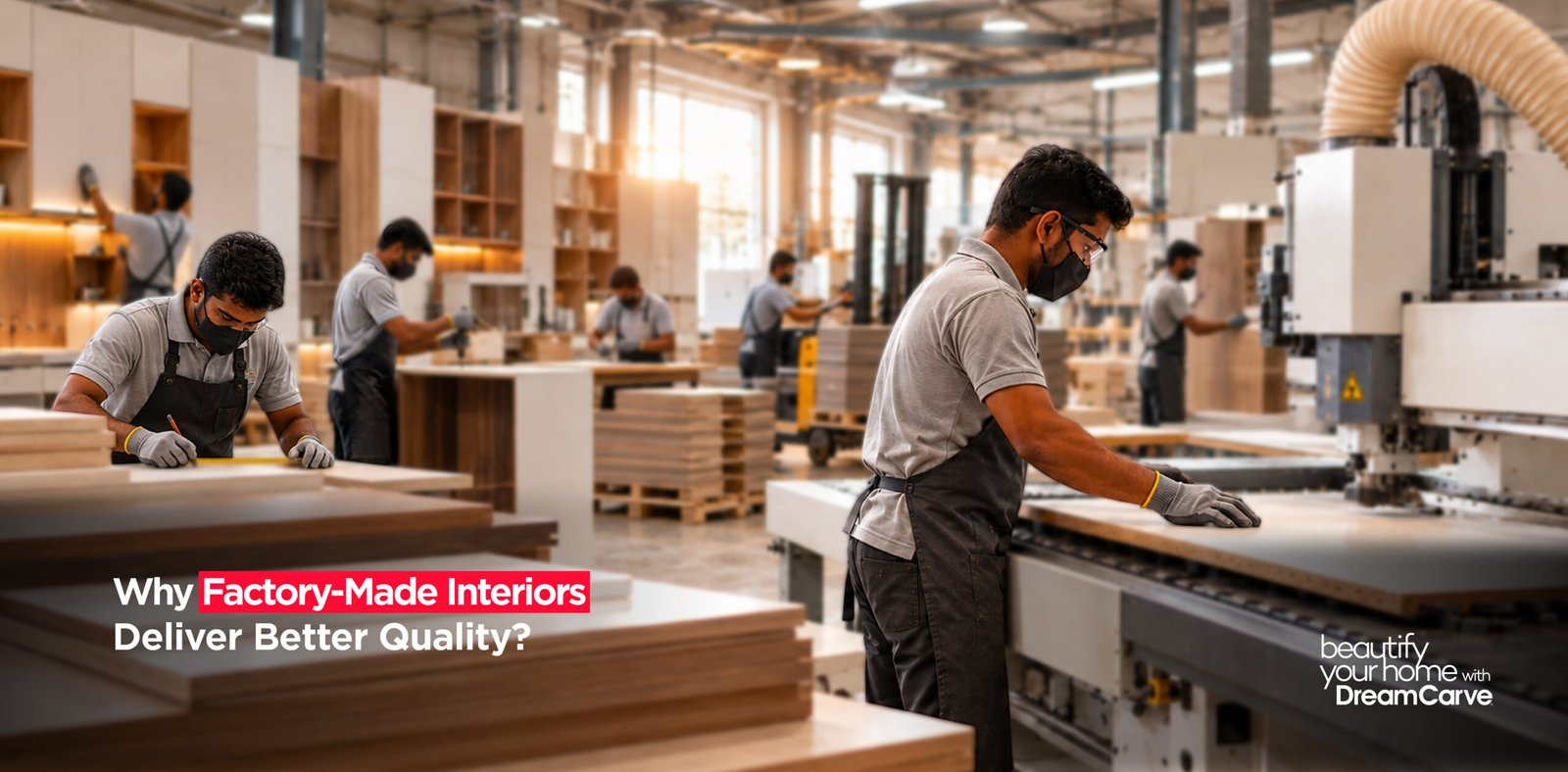
This is where the factory-made interior process becomes different. DreamCarve launched its 7,000 sq. ft. in-house modular manufacturing unit in 2023. The facility brings production and craftsmanship together under one roof, helping the team manage the journey from design to finished components.
Instead of treating every home as a completely new on-site production challenge, factory manufacturing follows a planned workflow. Materials are prepared for the approved design. Components are cut to the required dimensions. Edges are finished, parts are assembled where appropriate, and the pieces are checked before moving to the next stage.
This organised process helps the team maintain consistency across multiple components.
Consider a wardrobe with several shutters and drawers. If each piece is made separately on-site, repeated cutting and adjustments can make consistent dimensions and finishing more difficult to manage. In a planned manufacturing process, the components can be produced against the same specifications.
The result is a more controlled production journey. For homeowners looking for factory-made interiors in Madurai, this means choosing a process built around planning, precision and professional execution.
Precision Cutting: Why Every Millimetre Matters
A beautiful interior is not created by the design alone. The accuracy of its individual components matters just as much.
Think about a modular kitchen. Cabinet doors need to align properly. Drawers must fit their designated spaces. Corners should meet neatly, and the available space must be used efficiently. Even small measurement differences can affect the final appearance or functionality.
In factory-made interiors, components can be cut according to approved measurements using appropriate cutting equipment and repeatable production methods. This helps reduce avoidable measurement variations and makes it easier to reproduce matching components.
The next step is equally important: checking the dimensions against the design before the pieces move forward. Imagine opening a wardrobe where the shutters align neatly, the drawers move smoothly and the storage sections use the available space effectively. These details may seem small, but they influence how your home feels and functions every day.
Precision is not just about making furniture look straight. It is about making every component work as part of a complete design.
Quality Control: The Difference You Can See and Feel
A polished finish is not an accident. It is the result of attention to detail at different stages of production.
In traditional on-site carpentry, inspection often happens while the work is being assembled in the home. Some problems may only become visible after several components have been fitted together.
Factory manufacturing creates opportunities to check components before they reach the site.
A quality-checking process can include:
- Dimension checks: Confirming that components match the approved measurements.
- Edge finishing: Checking exposed edges for neatness and consistency.
- Surface inspection: Looking for visible scratches, chips, finishing defects or damage.
- Hardware checks: Verifying that hinges, channels and other fittings are suitable for their intended use.
- Assembly checks: Confirming alignment and fit where components are assembled before delivery.
- Final verification: Checking finished components against the design and material specifications.
These checks should be part of a clearly defined workflow rather than left until the end.
The advantage is simple: identifying a problem before delivery can make it easier to correct than discovering it after the furniture has been installed.
Less Dust, Less Noise, Less Disruption at Home
One of the biggest concerns homeowners have during interior work is the disruption it creates.
Cutting boards, sanding surfaces and preparing components inside a finished home can produce dust and noise. Workers, tools and materials may occupy rooms that the family needs to use every day.
This is especially challenging when homeowners have children, elderly family members, work-from-home routines or neighbours living close by. Factory-made interiors change where much of this work happens.
Cutting, component preparation and much of the finishing take place in the manufacturing unit. The finished components are then transported to the home for installation. This reduces the amount of cutting and fabrication that needs to happen on-site.
It does not mean that every installation is completely dust-free or silent. Drilling, fixing, adjustments and other installation activities may still create some dust and noise. However, moving most manufacturing away from the home can significantly reduce the disruption associated with on-site production.
At DreamCarve, the philosophy is straightforward: manufacture in the factory, install at the site, and make the process more comfortable for homeowners.
6. From Design to Installation: The Journey of Every Modular Interior
What happens after you approve your interior design?
The factory-made interior process connects several stages into one planned journey. Each stage prepares the project for the next.
Step 1: Understanding Your Home
The process starts with a discussion about your needs, lifestyle, budget and preferred design.
Whether you need a modular kitchen, a wardrobe, a TV unit or complete home interiors, the design should respond to how you actually use your space.
Step 2: Site Measurement
The team visits your home to take the necessary measurements and assess the available space.
Wall dimensions, corners, openings and relevant site conditions help determine how the components should be designed and manufactured.
Accurate measurement is essential because factory-produced components must fit the actual site.
Step 3: Design Finalisation
The design, layout, materials, colours, finishes and required hardware are finalised before production.
This is the stage to confirm important details and resolve design questions before manufacturing begins.
Step 4: Factory Manufacturing
Approved components move into production.
Cutting, edge finishing, surface preparation and other relevant fabrication activities are carried out in the manufacturing unit according to the project specifications.
Step 5: Quality Checking
The components are checked for dimensions, finish and fit as appropriate to the design.
Any identified issues can be addressed before the components are transported to the home.
Step 6: Delivery and Installation
The finished components are delivered to the site and installed according to the approved layout.
The team aligns the units, fixes the necessary hardware, makes required installation adjustments and checks the completed work.
Step 7: Final Inspection
The finished interiors are reviewed to identify any snags that need attention before handover.
This final stage helps ensure that the delivered result matches the agreed design and functional requirements as closely as possible.
When these stages are planned and coordinated properly, the homeowner gets a clearer process, more predictable execution and fewer avoidable surprises.
Factory-Made Interiors vs Traditional Carpentry: What Is the Difference?
Both methods can produce beautiful interiors when handled by skilled professionals. The difference lies mainly in where the work happens and how the process is organised.
| Factor | Factory-Made Interiors | Traditional On-Site Carpentry |
|---|---|---|
| Production location | Most fabrication takes place in a manufacturing unit | Much of the fabrication takes place at the home |
| Cutting and preparation | Components are prepared before delivery | Cutting and preparation may happen during installation |
| Quality control | Checks can take place at several production stages | Checks often take place during on-site fabrication and fitting |
| Finishing consistency | Repeatable production methods can support consistent finishes | Consistency depends heavily on workmanship and site conditions |
| Dust and noise | Less on-site fabrication can reduce disruption | On-site cutting and sanding can create more disruption |
| Project scheduling | Production and site preparation may be coordinated | Work can depend more directly on on-site task sequencing |
| Customisation | Designs can be customised within the manufacturing system | Customisation can be carried out directly on-site |
| Installation | Pre-manufactured components are fitted at the site | Furniture is often fabricated and assembled at the site |
The right choice depends on the design, materials, budget, site conditions and skill of the people carrying out the work.
Factory-made interiors are particularly useful when homeowners want a planned modular solution with consistent components, controlled finishing and a more organised installation process. Traditional carpentry can still be suitable for unique site-specific work, intricate custom details or situations where direct on-site fabrication is more practical.
The goal is not to dismiss traditional craftsmanship. It is to combine skilled craftsmanship with a process that helps make quality more consistent.
Are Factory-Made Interiors a Better Long-Term Investment?
When planning interiors, the initial quotation is only one part of the decision.
Homeowners should also consider finishing quality, material suitability, installation accuracy, storage functionality, maintenance and the expected lifespan of the components.
Factory manufacturing can help improve consistency, reduce avoidable rework and organise production more efficiently. These advantages can contribute to long-term value when the materials and workmanship are appropriate for the intended use.
But factory-made does not automatically mean that every product is superior or more durable. The quality of the boards, hardware, edge treatment, installation and maintenance still matters.
Before selecting an interior provider, ask these questions:
- What materials and thicknesses are being proposed?
- Which hardware brands and specifications are included?
- How are exposed edges and moisture-prone areas treated?
- What quality checks take place before delivery?
- What is included in the installation and handover?
- What warranty or after-sales support is provided?
- What is the expected project timeline, and what could affect it?
A reliable provider should be able to explain these details clearly.
DreamCarve’s website highlights a 30-day snag-point warranty for minor defects or issues covered under its stated terms. Confirm the current warranty scope and project-specific conditions with the team before booking.
Why Choose DreamCarve for Factory-Made Interiors in Madurai?
Choosing an interior company is about more than selecting a design you like. You are also choosing the team, production process and project management that will turn that design into your home.
DreamCarve began in 2018 with a focus on bringing design and technical planning together to create functional living spaces. In 2023, the company launched its 7,000 sq. ft. in-house modular manufacturing unit in Madurai.
Its service offering includes modular kitchens, wardrobes, TV units, storage solutions, bedroom interiors, one-room interiors, full-home interiors and renovations.
For homeowners in Madurai who want well-planned interiors without the unnecessary disruption of extensive on-site fabrication, this approach is worth considering.
Whether you are planning a new home or upgrading an existing space, the focus should remain the same: functional design, suitable materials, careful manufacturing and professional execution.
Conclusion: Better Interiors Begin with a Better Process
Your dream home deserves more than attractive designs. It deserves a process that values accuracy, quality, functionality and your time.
For homeowners looking for factory-made interiors in Madurai, the real benefit is not simply a finished kitchen or wardrobe. It is the confidence that comes from knowing how your interiors are planned, produced and installed.
At DreamCarve, a 7,000 sq. ft. in-house manufacturing unit supports this journey from approved design to finished space.
Your dream home deserves precision at every step. Ready to Transform Your Home with Factory-Made Interiors?
Planning a modular kitchen, wardrobe or complete home interior in Madurai? Connect with DreamCarve to discuss your space, explore customised design options and understand how factory-made interiors can work for your home.